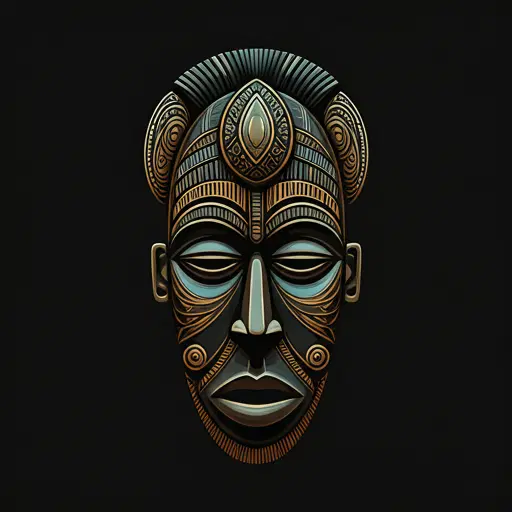
The term “tribal tattoo” has become one of the most searched tattoo phrases in the world. But what does it actually mean? In Western tattoo culture, “tribal” usually refers to bold black geometric patterns inspired loosely by Polynesian, African, and other indigenous body art traditions. But behind the aesthetic lies a vast and deeply meaningful history of body modification practiced across Africa for thousands of years. This guide looks beyond the surface to explore the real traditions of African body marking — scarification, tattooing, body painting, and branding — and their profound significance in the cultures that created them.
History of African Body Marking
Body marking in Africa is ancient. Archaeological evidence from across the continent suggests that humans have been modifying their skin for tens of thousands of years. The oldest known potential evidence of tattooing comes from figurines and human remains in North Africa dating back to at least 3000 BCE, while scarification tools have been found in archaeological sites across sub-Saharan Africa that are considerably older. The practice was not marginal — it was central to social life in hundreds of African cultures, serving functions that Western societies typically assign to written documents, uniforms, and identity cards.
In precolonial Africa, your body markings told the world who you were: your ethnic group, your clan, your age grade, your marital status, your social rank, your spiritual affiliations, and your personal history. Among the Yoruba of southwestern Nigeria, facial marks called ila identified a person’s family lineage and hometown. Among the Dinka of South Sudan, patterns of raised scars on the forehead marked a boy’s transition to manhood. Among the Nuba of Sudan, women’s bodies were progressively decorated with scarification patterns at puberty, after first childbirth, and after weaning, creating a visible biography inscribed on the skin.
European colonizers frequently misunderstood and demonized African body marking, categorizing it as “savage” or “primitive.” Colonial administrations in British, French, and Portuguese Africa actively discouraged scarification and other body modifications, associating them with the indigenous social structures they sought to dismantle. Missionaries reinforced this by teaching that body marking was incompatible with Christianity. These pressures, combined with urbanization and changing aesthetics, led to a significant decline in traditional body marking across much of Africa during the twentieth century. Yet the traditions never disappeared entirely, and they are experiencing renewed interest among younger generations seeking to reconnect with heritage.
Scarification vs Tattoo
Scarification and tattooing are fundamentally different techniques that are often confused. Tattooing involves inserting pigment (ink, ash, or other colorants) under the skin using needles or sharp instruments. The result is a permanently colored design visible beneath the skin’s surface. Scarification involves deliberately wounding the skin through cutting, branding, or abrasion to produce raised scars (keloids) that form permanent, three-dimensional patterns on the skin’s surface.
Scarification became the dominant form of body marking in sub-Saharan Africa largely because of skin tone. On darker skin, ink-based tattoos are often difficult to see, whereas raised scars are prominently visible and can be felt by touch. The tactile quality of scarification added another dimension of meaning — in intimate contexts, partners could “read” each other’s body stories through touch as well as sight. The process of scarification was also significant: enduring the pain of cutting was itself a test of courage, patience, and willingness to submit to community norms.
Traditional scarification techniques varied widely. Among the Tiv people of central Nigeria, designs were cut into the skin with razor-sharp blades, and ash or plant sap was rubbed into the wounds to promote keloid formation. Among the Nuba of Sudan, cuts were made and then reopened multiple times during healing to ensure prominent scarring. Branding, using heated metal tools, was practiced in some communities in West and East Africa. Each technique produced distinct visual effects — fine lines, dots, raised ridges, or broad keloid masses — and the choice of technique was part of a community’s specific aesthetic tradition.
Regional Traditions
West Africa: The Yoruba ila (facial marks) are perhaps the most widely discussed West African body marking tradition. Specific patterns identified the wearer’s city of origin: residents of Oyo, Ibadan, Ogbomosho, and other Yoruba city-states each bore distinctive marks. Among the Itsekiri people of the Niger Delta, body marks carried ceremonial and spiritual significance, particularly for members of the royal court and priesthood. The Tiv people of the Benue region practiced some of the most elaborate torso scarification in Africa, with patterns covering the chest, abdomen, and back in intricate geometric designs that took years to complete.
East Africa: The Maasai of Kenya and Tanzania practice earlobe stretching and scarification as part of age-grade transitions. The Mursi and Surma peoples of Ethiopia’s Omo Valley are known for lip plates (worn by women) and elaborate scarification designs that mark beauty, bravery, and social status. Among the Dinka and Nuer of South Sudan, forehead scarification — a series of parallel lines cut across the brow — marks the transition from boyhood to manhood and identifies ethnic affiliation.
Central and Southern Africa: The Luba and Lunda peoples of the Congo basin practiced abdominal scarification with designs that communicated lineage, spiritual status, and aesthetic ideals. Among the Kongo, body markings were connected to nkisi spiritual practice, with specific scar patterns believed to activate or channel spiritual power. In southern Africa, the Xhosa practiced facial scarification as part of initiation, and the San peoples used small scarification marks in healing rituals where medicinal substances were rubbed into cuts to enter the bloodstream.
Meanings: Identity, Beauty, Spiritual Protection & Status
Identity and belonging: The most universal function of African body marks was identification. In a continent of enormous ethnic, linguistic, and cultural diversity, body marks told strangers exactly where you came from and who your people were. This had practical implications: if you were lost, captured in war, or traveling far from home, your marks could identify you and potentially secure your safe return or fair treatment.
Beauty and attraction: In many cultures, scarification patterns were considered essential to physical beauty. Among the Nuba, a woman without scarification was considered incomplete and less attractive. Among the Tiv, a fully scarified torso was a sign of maturity, courage, and sexual readiness. The aesthetic standards were culturally specific — what was considered beautiful among the Dinka differed profoundly from Yoruba or Maasai standards — but the principle was consistent: body modification was an enhancement of natural beauty, not a deviation from it.
Spiritual protection: Many African body marks served apotropaic functions — they warded off evil spirits, disease, and misfortune. Small cuts near the eyes, mouth, or temples were common in West Africa, where they were believed to protect vulnerable openings in the body from spiritual attack. Medicinal substances rubbed into scarification cuts were believed to provide ongoing spiritual protection, functioning as a permanent form of the protective charms and amulets that were also widely used. Among the Itsekiri, ceremonial marks connected the bearer to the spiritual authority of the ancestors and the orisha.
Status and achievement: Scarification often marked transitions and achievements: completion of initiation, first kill in a hunt, valor in battle, childbirth, or elevation to political or spiritual office. These marks were earned, not chosen casually, and they carried the authority of the community that bestowed them. A warrior’s scars were as respected as a general’s medals; a mother’s birth marks were as honored as any formal title.
The Debate Over “Tribal” Tattoos
The Western “tribal tattoo” trend that exploded in the 1990s and remains popular today raises legitimate questions about cultural appropriation. The designs typically associated with this trend — bold black armbands, symmetrical patterns on shoulders and backs, abstract curvilinear shapes — draw heavily from Polynesian (particularly Maori, Samoan, and Hawaiian) and, to a lesser extent, African and Borneo traditions. They are often chosen purely for aesthetic reasons, without any understanding of or connection to the cultures that created them.
Critics argue that stripping these designs of their cultural meaning reduces profound traditions to fashion accessories. When a Maori ta moko or a Dinka forehead scar pattern is replicated on someone who has no connection to those cultures and no understanding of what the marks signify, the criticism is that the aesthetics are being consumed while the people and histories behind them are ignored. This is compounded by the historical context: the same body marking practices that are now considered fashionable were condemned as “savage” when practiced by colonized peoples.
Defenders of tribal-style tattoos counter that body art has always been a cross-cultural practice, that admiration for a design tradition is not inherently disrespectful, and that gatekeeping body art along ethnic lines is itself problematic. The most constructive path forward involves education: learning the specific cultural origins of the designs you admire, crediting those traditions openly, supporting artists from those communities, and being honest about the difference between wearing a symbol because it means something to you personally and wearing it because it was earned within a cultural framework you do not belong to.
Modern African-Inspired Tattoos
A growing movement of African and diaspora tattoo artists is creating contemporary work that draws on African symbol systems with knowledge, intentionality, and cultural grounding. These artists work with clients to select symbols that resonate with their personal heritage and values, creating custom designs rooted in Adinkra, ancient Egyptian, Nsibidi, and other African visual traditions.
Popular African-inspired tattoo themes include: the ankh (life and African heritage), the Sankofa bird (learning from the past), Gye Nyame (faith in the supreme being), geometric patterns inspired by Ndebele murals or Kuba textiles, portraits of African figures and deities, maps of Africa, and abstract designs inspired by scarification patterns. For guidance on choosing a design, see our African Tattoo Guide.
The emergence of dark-skin specialist tattoo artists has also expanded what is possible. Historically, mainstream tattoo culture assumed light skin, and many standard techniques and inks did not work well on darker complexions. Artists specializing in dark skin tattooing use techniques and color palettes optimized for melanin-rich skin, enabling people of African descent to access tattoo art that looks vibrant and defined on their bodies.
Cultural Respect
If you are drawn to African body art traditions, here is how to engage respectfully. First, educate yourself about the specific tradition that inspires you. There is a vast difference between Yoruba ila, Maasai beadwork, Dinka forehead scars, and Adinkra symbols — they are not interchangeable. Second, understand the context: some marks are earned through initiation or achievement and are not meant to be worn by outsiders. Third, seek out artists who have genuine knowledge of the tradition, ideally artists of African descent who bring cultural as well as technical expertise.
Fourth, be transparent about your intentions. If you are of African descent reclaiming a heritage that was disrupted by colonialism or the slave trade, that is a meaningful and widely respected motivation. If you are not of African descent but are genuinely moved by a symbol’s meaning, say so honestly rather than claiming a false connection. Fifth, support the living cultures behind the symbols: buy from African artisans, amplify African voices, and acknowledge that the beauty you admire is the product of specific peoples with specific histories.
African body art is not a trend — it is one of humanity’s oldest forms of self-expression, with roots stretching back to the earliest human communities. Approaching it with knowledge and respect transforms a tattoo from mere decoration into a genuine act of cultural connection. Explore our African Tattoo Guide for specific design ideas and our African Symbols guide for a comprehensive overview of the visual traditions that inspire the best African-inspired body art.
Continue your exploration of African body art
Ready for design ideas? See our African Tattoo Guide for specific designs and placements, or browse African Symbols and Their Meanings for the full visual vocabulary of the continent.