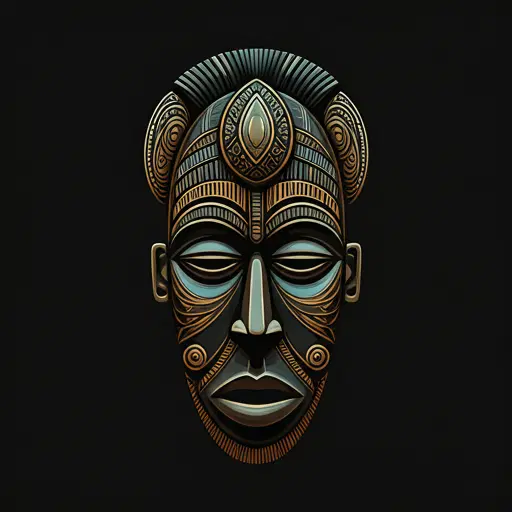
Every culture communicates through symbols, but Africa’s visual traditions are among the oldest and most diverse on earth. The continent is home to thousands of ethnic groups, hundreds of languages, and dozens of distinct symbol systems — each with its own grammar, aesthetics, and purpose. Some, like Egyptian hieroglyphs, have been studied for centuries. Others, like Nsibidi, are only now receiving the scholarly attention they deserve. This guide offers a panoramic view of African symbols and their meanings, organized by region and tradition. Whether you are exploring your heritage, looking for tattoo inspiration, or simply want to understand the depth of African visual culture, this is your starting point.
Why Symbols Matter in Africa
In many African societies, symbols are not decorative afterthoughts. They are primary vehicles for transmitting knowledge across generations. Before the widespread adoption of Latin-script literacy, and alongside Africa’s own indigenous writing systems, visual symbols served as repositories of law, philosophy, genealogy, and spiritual practice. A single Adinkra stamp on a funeral cloth could communicate a proverb that an elder might take an hour to explain verbally. A pattern of Nsibidi marks on a calabash could record a judgment in a village court. The ankh pressed to the lips of a pharaoh was not art for art’s sake — it was a ritual act conferring divine life.
Symbols also function as identity markers. Among the Itsekiri people of southern Nigeria, coral beads worn in specific configurations communicate royal lineage, priestly authority, or marital status. Among the Maasai of Kenya and Tanzania, the colors and patterns of beaded jewelry convey age group, social status, and community affiliation. In West Africa, textiles like kente cloth use specific weaving patterns to represent historical events, clan identities, and moral principles. The symbol, in African context, is simultaneously art, language, law, and philosophy.
Understanding African symbols matters beyond academic interest. In the African diaspora, symbols like the ankh, Sankofa, and Gye Nyame have become powerful tools for cultural reclamation. They allow people whose ancestors were stripped of their names, languages, and traditions to reconnect with a heritage that predates the trauma of enslavement and colonization. They are also increasingly visible in global fashion, design, and art — which makes understanding their original context essential for respectful use.
Adinkra Symbols (Ghana)
The Adinkra symbols of the Akan people represent one of the most complete visual philosophy systems in the world. Originating in what is now Ghana and Ivory Coast, Adinkra comprises more than eighty distinct symbols, each encoding a specific proverb, concept, or historical reference. The word “Adinkra” is believed to derive from the name of a defeated king, Nana Kofi Adinkra of Gyaman, whose cloth was captured and replicated by the Asante. The tradition of stamping these symbols onto cloth using carved calabash stamps and a dye made from the bark of the Badie tree is at least several hundred years old.
Among the most well-known Adinkra symbols are Gye Nyame(“Except God”), which affirms the supremacy of the supreme being; Sankofa(“Go back and fetch it”), which teaches the importance of learning from the past; Dwennimmen (ram’s horns), which represents humility combined with strength; and Nyame Nti (“By God’s grace”), which symbolizes faith and trust in divine providence. Each symbol is a compressed lesson — a visual equivalent of an elder’s wisdom that can be printed on cloth, carved into architecture, or tattooed on skin.
Adinkra cloth was traditionally reserved for funerals and solemn occasions, but today Adinkra symbols appear on everything from government buildings to corporate logos to fashion accessories. The Ghanaian parliament building features Adinkra motifs. The African Union has drawn on Adinkra aesthetics. In the diaspora, Adinkra symbols are among the most popular choices for African symbol tattoos, home decor, and identity jewelry. Their accessibility — each symbol comes with a clear proverb and meaning — has made them a gateway for many people into the broader world of African symbolism.
Nsibidi (Nigeria)
Nsibidi is an indigenous system of ideographic writing that originated among the Ejagham people of southeastern Nigeria and western Cameroon. It was adopted and expanded by the Igbo, Efik, Ibibio, and other peoples of the Cross River region. Nsibidi is remarkable because it developed entirely independently of outside influence — it is an African-invented writing system that predates European contact by centuries. Archaeological evidence, including Nsibidi-like marks on pottery and ritual objects, suggests the system may be over a thousand years old.
Nsibidi symbols were used to record court judgments, communicate messages between villages, write love letters, mark territory, and encode the secret knowledge of societies like the Ekpe (Leopard) society. The symbols range from simple representational marks — two parallel lines representing a couple, a wavy line representing a river — to highly abstract ideograms that require initiation to interpret. This dual nature, with public symbols visible to everyone and esoteric symbols restricted to initiates, gave Nsibidi a layered complexity that parallels the hieratic and demotic divisions of Egyptian writing.
Colonial authorities suppressed Nsibidi along with the secret societies that maintained it, viewing both as threats to colonial order. As a result, fluent knowledge of the system has diminished, though it has never disappeared entirely. Contemporary Nigerian artists, scholars, and cultural activists are working to document and revive Nsibidi, and its aesthetic influence is visible in modern Nigerian graphic design, fashion, and visual art. The Itsekiri people, neighbors of the Nsibidi-using cultures in the Niger Delta, share some symbolic traditions around body marking and ritual inscription, reflecting the cultural exchange networks that have always connected the peoples of southern Nigeria.
Egyptian Hieroglyphs
No discussion of African symbols is complete without the hieroglyphic writing system of ancient Egypt. Developed around 3200 BCE, Egyptian hieroglyphs are one of the oldest known writing systems on earth and the oldest in Africa. The system combined logographic and alphabetic elements: some symbols represented whole words or concepts (like the ankh for “life”), while others represented individual sounds. At its most complex, the hieroglyphic system comprised over seven hundred distinct signs.
Hieroglyphs were used for monumental inscriptions on temple walls, pyramids, and obelisks. A simplified version, hieratic, was used for everyday administrative and literary purposes. A further simplification, demotic, became the standard script of the late Egyptian period. The Rosetta Stone, which bore the same text in hieroglyphic, demotic, and Greek, famously enabled Jean-François Champollion to crack the hieroglyphic code in 1822. Key symbols that transcended their linguistic function to become cultural icons include the ankh (life), the Eye of Horus (protection), the scarab (rebirth), and the djed pillar (stability).
Egypt’s position in northeastern Africa has sometimes led to its cultural contributions being separated from the rest of the continent in popular imagination. But Egyptian civilization was unambiguously African: it grew from Nile Valley cultures whose roots extended into Nubia and the central Sahara. The hieroglyphic tradition influenced the Meroitic script of the Kushite kingdom (modern Sudan) and may have indirectly influenced other African writing systems. Recognizing hieroglyphs as African symbols — rather than as a separate “Middle Eastern” or “Mediterranean” tradition — is essential to understanding the full scope of African intellectual achievement.
Berber / Amazigh Symbols
The Amazigh (Berber) peoples of North Africa possess one of the continent’s oldest surviving scripts: Tifinagh. Evidence of Tifinagh inscriptions has been found across the Sahara, from Libya and Tunisia to Morocco and the Canary Islands, with some dating back more than two thousand years. The script has been maintained most continuously by the Tuareg people of the central Sahara, where it is still used today alongside Arabic and French. In 2003, Morocco officially recognized Tifinagh as one of its national scripts, and it is now taught in schools and displayed on government buildings.
Beyond the Tifinagh script, Amazigh culture is rich in geometric symbols that appear in textiles, pottery, jewelry, and tattoos. Common motifs include the diamond (representing the eye or female fertility), zigzag lines (water or serpents), the cross (the four cardinal directions), and the open palm (protection, related to the Hamsa). These symbols predate Islam in North Africa and carry meanings rooted in pre-Islamic Amazigh spirituality, though they have been reinterpreted within Islamic cultural frameworks over the centuries. Amazigh women traditionally wove these symbols into carpets and embroidered them onto garments, creating textiles that functioned as visual libraries of cultural knowledge.
The revival of Amazigh identity across North Africa has brought renewed attention to these symbols. The Amazigh flag, adopted in 1997, features Tifinagh characters, and Amazigh cultural organizations worldwide use traditional geometric motifs in their branding and advocacy materials. The Amazigh symbol tradition is a powerful reminder that North Africa’s cultural heritage extends far beyond the Arab and Islamic traditions that arrived in the seventh century — the Amazigh have been in Africa for thousands of years, and their symbols reflect that deep history.
East African Symbols
East Africa’s symbolic traditions are diverse and often embedded in material culture rather than written scripts. Among the Maasai of Kenya and Tanzania, beadwork functions as a visual language. Colors carry specific meanings: red symbolizes bravery and blood, blue represents the sky and water (provided by God), green represents the land and vegetation, white symbolizes peace and purity, and orange represents hospitality. The patterns in which these colors are arranged communicate age group, social status, and personal history.
Ethiopia possesses one of the most significant script traditions in Africa: the Ge’ez syllabary, which has been in continuous use for over two thousand years. Originally developed for the Ge’ez language, the script was adopted for Amharic, Tigrinya, and other Ethiopian languages. It remains the liturgical script of the Ethiopian Orthodox Church and is used daily by over one hundred million people. Ethiopia is also home to a rich tradition of painted religious art, with iconic symbols including the Ethiopian cross (with its elaborate interlocking patterns), the Ark of the Covenant motif, and the Lion of Judah — symbols that blend indigenous African and Christian traditions.
Along the Swahili coast, centuries of trade with Arabia, Persia, India, and Southeast Asia produced a unique fusion culture with its own symbolic vocabulary. Swahili doors, particularly in Zanzibar and Lamu, are carved with elaborate patterns whose motifs include lotus flowers (Indian influence), chain links (Arabic geometric tradition), and frankincense burners (local Swahili spiritual practice). These doors were not merely decorative — the motifs communicated the owner’s wealth, trade connections, and social status.
South African Symbols
Southern Africa is home to some of the oldest visual art in human history. The San (Bushmen) rock paintings of South Africa, Botswana, Namibia, and Zimbabwe date back tens of thousands of years, making them among the oldest artistic traditions on earth. These paintings depict animals, human figures, geometric patterns, and therianthropic (half-human, half-animal) beings that scholars believe represent shamanic trance experiences. The eland (a large antelope) appears with particular frequency, symbolizing spiritual potency, rain-making power, and the connection between the physical and spirit worlds.
The Zulu people of South Africa use a system of beadwork communication called “love letters” (incwadi), in which young women send beaded messages to suitors. Colors and patterns encode specific emotional and social meanings: white represents purity and true love, black represents marriage or darkness, red represents deep passion, yellow represents wealth, and blue represents faithfulness. The arrangement of these colors into geometric patterns creates layered messages that can express longing, rejection, inquiry, or commitment.
The Ndebele people, also of South Africa, are renowned for their brightly painted house murals featuring bold geometric patterns. These murals, traditionally painted by women, use specific color combinations and shapes that identify family lineages and mark important life events. The tradition became a form of cultural resistance during the apartheid era, when the South African government forcibly relocated Ndebele communities. The murals, painted defiantly onto the walls of resettlement housing, became symbols of cultural persistence and identity in the face of dispossession.
Symbols in Modern Life
African symbols have moved far beyond their traditional contexts. They appear on runways in Paris and Milan, in graphic design studios in Lagos and Nairobi, on album covers in Atlanta and London, and in tattoo parlors worldwide. This global circulation brings both opportunity and responsibility. The opportunity is that African visual traditions are receiving recognition as some of the most sophisticated and beautiful in human history. The responsibility is ensuring that this recognition comes with understanding, attribution, and respect.
In fashion, designers like Duro Olowu, Lisa Folawiyo, and Ozwald Boateng have incorporated African symbols into high fashion, bringing Adinkra, kente, and Nsibidi-inspired motifs to global audiences. In architecture, buildings across Africa and the diaspora feature Adinkra motifs, Ndebele patterns, and Egyptian-inspired columns. In the wellness and spirituality space, symbols like the ankh, the Eye of Horus, and Yoruba orisha iconography have found new audiences among people seeking alternatives to Western spiritual traditions. And in the African diaspora, symbols serve as bridges to a heritage that colonialism and the slave trade attempted to sever.
If you want to use African symbols — in a tattoo, in your home decor, in a design project — take time to learn their origins and meanings. Visit our in-depth guides to individual symbol traditions: the ankh, Adinkra symbols, Sankofa, African patterns, and the cowrie shell. Understanding the context behind the symbol transforms it from a pretty design into a meaningful connection to one of humanity’s oldest and richest cultural traditions.
Explore the full African Symbols collection
This overview is your map. Now go deeper: explore our detailed guides to the ankh, Adinkra symbols, Sankofa, and cowrie shells. INC-USA’s Cultural Preservation Initiative works to document and share these traditions with the next generation.