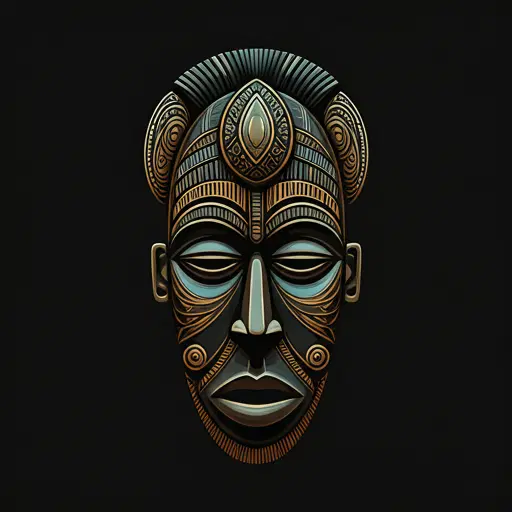
Walk through any market in Lagos, Accra, Nairobi, or Johannesburg and you are surrounded by African patterns — bold geometric prints on fabric, intricate beadwork on jewelry, carved motifs on furniture, and painted designs on walls. These patterns are not random decoration. They are visual languages developed over millennia, carrying messages about identity, social status, spiritual belief, and community belonging. From the mathematically precise woven strips of kente cloth to the resist-dyed indigo swirls of adire, African pattern traditions represent some of the most sophisticated design systems ever created. This guide traces the history, regional diversity, symbolism, and modern global influence of African patterns — including the distinctive pattern traditions of the Itsekiri people of Nigeria’s Delta State.
What Are African Patterns?
African patterns are repeating visual motifs created by the peoples of the African continent and its diaspora. They appear in textiles, pottery, architecture, body art, basketry, metalwork, and wood carving. What distinguishes African patterns from mere ornament is their communicative function: in most African cultures, patterns are read, not just seen. A specific arrangement of zigzags on a Zulu beaded necklace communicates the wearer’s marital status. A particular kente weave pattern is reserved for royalty. A mudcloth motif in Mali records the specific life events of the woman who made it. Pattern-making in Africa is a form of visual literacy — a way of writing without alphabets.
The range of African pattern traditions is staggering. The continent is home to over two thousand distinct ethnic groups, and virtually all of them have developed unique pattern vocabularies. Some patterns are geometric and abstract — grids, spirals, tessellations, and fractal-like structures that anticipate mathematical concepts formalized in Europe only centuries later. Others are figurative, incorporating stylized representations of animals, plants, celestial bodies, and human figures. Many blend both approaches, embedding figurative symbols within geometric frameworks. The common thread is intentionality: African patterns mean something, and the people who create them know exactly what they mean.
It is important to resist the outdated colonial habit of calling African patterns “tribal” or “primitive.” These terms obscure the extraordinary technical and intellectual achievement that African pattern-making represents. Researchers in ethnomathematics have demonstrated that African artisans independently developed concepts including fractal geometry, binary recursion, tessellation, and self-similar scaling — often centuries before these ideas were formalized in Western academic mathematics. African patterns are not naive; they are brilliant.
History of African Pattern-Making
The history of African pattern-making extends deep into prehistory. Rock art sites across the Sahara, the Horn of Africa, and southern Africa contain geometric motifs — concentric circles, crosshatching, zigzag lines, and dot matrices — dating back tens of thousands of years. The Blombos Cave in South Africa yielded ochre pieces engraved with geometric crosshatch patterns dated to approximately 77,000 years ago, making them among the oldest known examples of abstract pattern-making by humans anywhere in the world. These Blombos engravings suggest that the impulse to create structured, repeating patterns is not merely cultural but deeply embedded in human cognition — and that this cognitive capacity was first expressed in Africa.
As African societies developed agriculture, metallurgy, long-distance trade, and urbanization, their pattern traditions became more complex and more socially codified. In ancient Egypt, geometric patterns adorned temples, tombs, furniture, and textiles for thousands of years, influencing Greek and Roman decorative arts. In the kingdoms of West Africa, textile production became a major industry: the strip-weaving traditions that would eventually produce kente cloth in the Akan region were already established by the eleventh century. In East Africa, Swahili coastal cities developed distinctive architectural patterns influenced by trade with Arabia, Persia, and India, while maintaining underlying African geometric structures.
The transatlantic slave trade disrupted many pattern traditions but also created new ones. Enslaved Africans in the Americas carried pattern knowledge in their memories and their hands. The quilting traditions of the American South, the wrought-iron balcony designs of New Orleans, and the geometric face-painting traditions preserved in Maroon communities across the Caribbean and South America all trace their pattern DNA to African sources. In Africa itself, colonialism introduced new materials (particularly industrially produced cotton cloth and synthetic dyes) that African artisans adapted to their existing pattern vocabularies — a creative act of cultural resilience that produced the vibrant ankara and wax-print traditions that define West African fashion today.
Regional Pattern Traditions
Africa’s pattern traditions are as diverse as its geography and peoples. In West Africa, the dominant pattern tradition is textile-based. Ghana’s kente cloth features complex strip-woven geometric designs in vivid colors, each pattern combination carrying a specific name and proverbial meaning. Nigeria alone is home to multiple distinct textile pattern systems: the Yoruba produce adire (indigo resist-dyed cloth with stenciled or hand-drawn patterns), aso-oke (strip-woven prestige cloth), and the finely embroidered babban riga robes of the northern Hausa. The Igbo and Ibibio peoples developed the nsibidi symbol system, which includes geometric patterns used in ritual contexts.
In Central Africa, the Kuba people of the Democratic Republic of Congo created one of the most complex pattern traditions on the continent. Kuba raffia cloth features interlocking geometric designs — diamonds, interlaces, zigzags, and spirals — that are cut-pile embroidered with a precision that has astonished textile scholars. Each pattern has a specific name, and the most complex designs are associated with royalty. The Kuba are also renowned for their carved wooden boxes, cups, and masks, all featuring the same geometric vocabulary.
In East Africa, pattern traditions tend toward beadwork, body painting, and basketry rather than woven textiles. The Maasai of Kenya and Tanzania produce elaborate beaded jewelry with geometric color patterns that communicate age, gender, marital status, and social position. Ethiopian and Eritrean women weave netela shawls with distinctive border patterns called tibeb, whose geometric designs vary by region. In southern Africa, the Ndebele people of South Africa paint their homes with bold geometric patterns in primary colors — a tradition that became a form of cultural resistance during apartheid, visually asserting Ndebele identity in the face of forced removals.
North Africa contributes the intricate geometric pattern traditions of Amazigh (Berber) carpet weaving and the Islamic geometric art found in mosques and madrasas from Morocco to Egypt. Amazigh carpet patterns use diamonds, lozenges, and zigzags to encode fertility, protection, and lineage information, while Islamic geometric art employs mathematically precise tessellations and star patterns that represent the infinite order of creation. Both traditions have deep pre-Islamic roots and represent some of the most geometrically sophisticated pattern-making anywhere in the world.
Geometric Symbolism
The geometric shapes that recur across African pattern traditions are not arbitrary. They constitute a shared symbolic vocabulary with regional variations. The triangle, found in patterns from the Sahel to the Cape, often represents femininity, the delta of a river, a mountain, or the concept of three-in-one (birth, life, death). Inverted triangles can signify masculinity or the pouring of water. Zigzag lines almost universally represent water — the lifeblood of agricultural societies — though they can also signify lightning, the path of a snake, or the ups and downs of human fortune.
Circles and spirals are among the most widespread motifs. Concentric circles frequently represent community (the individual at the center, surrounded by family, clan, and society), the sun, or the ripple effect of actions through the spiritual world. Spirals can signify growth, the passage of time, the DNA-like continuity of lineage, or the coiled energy of creation. The diamond or rhombus shape, formed by stacking two triangles, represents the meeting of opposites — male and female, earth and sky, the visible and invisible worlds — and appears in pattern traditions from Kuba cloth to Zulu beadwork to Amazigh carpets.
Crosshatching and grid patterns often represent cultivated land, ordered society, or the weaving of community bonds. The checkerboard, found in patterns from ancient Egypt to modern-day Ghana, can signify duality, strategic thinking, or the alternation of fortune. Fractal patterns — shapes that repeat at different scales — are particularly notable in African design. Researcher Ron Eglash has documented fractal structures in African village layouts, hairstyles, textile patterns, and spiritual divination systems, arguing that African cultures developed a practical, intuitive understanding of fractal geometry long before Benoit Mandelbrot coined the term in 1975.
Patterns in Textiles: Kente, Ankara, Adire, and Mudcloth
Kente cloth is perhaps the most internationally recognized African textile. Woven by Akan artisans in Ghana (particularly the Ashanti and Ewe peoples), kente is produced on narrow-strip looms that create bands of cloth approximately four inches wide, which are then sewn together to form larger garments. Each kente pattern has a specific name — often referencing a proverb, a historical event, or a social value — and the combination of colors and patterns communicates the wearer’s status, clan affiliation, and the occasion for which the cloth is worn. Kente patterns include Sika Futuro (gold dust, signifying wealth), Oyokoman (a royal pattern reserved for the Ashanti king), and Fathia Fata Nkrumah (named after Ghana’s first first lady).
Ankara (also called African wax print or Dutch wax print) is the everyday fabric of West Africa. Its bold, colorful, repeating patterns are printed onto cotton using a wax-resist technique. Despite its Dutch-Indonesian origins, ankara has been thoroughly claimed by African fashion: the most popular patterns carry Yoruba, Igbo, and Akan names, and the fabric is used for everything from baby wraps to wedding attire to corporate workwear. Ankara patterns range from geometric abstractions to representational designs featuring objects, animals, or text. To explore ankara in depth, visit our complete guide to ankara fabric.
Adire is the indigo resist-dyed cloth of the Yoruba people of southwestern Nigeria. The patterns are created by tying, stitching, folding, or stenciling cassava paste onto white cotton before immersing it in indigo dye. The resulting patterns — white on deep blue — include geometric grids, spirals, leaf motifs, and figurative designs. Adire patterns have specific names: Ibadadun (the capital is sweet) and Olokun (sea goddess) are among the best known. The technique is experiencing a revival among contemporary Nigerian designers.
Bogolanfini (mudcloth) is the signature textile of the Bamana people of Mali. The patterns are painted onto hand-woven cotton strips using fermented mud, which reacts chemically with the fabric to produce rich brown and black tones against a yellowish or white background. Mudcloth patterns are laden with meaning: specific motifs represent historical battles, proverbs about bravery or patience, and spiritual protections. Traditionally, mudcloth was made by women and worn during significant life transitions. Its distinctive patterns have been widely adopted in global fashion and interior design.
Patterns in Architecture
African patterns are not confined to textiles. Some of the most striking examples appear in architecture. The Ndebele houses of South Africa are famous for their exterior murals: bold geometric patterns in primary colors (red, blue, yellow, green, black) painted by women using natural pigments and, more recently, commercial house paint. These patterns evolved from simple fingertip-drawn designs in the early nineteenth century to the complex, multicolored geometric compositions that became a symbol of Ndebele cultural identity during the apartheid era. The patterns are not purely decorative; they communicate family status, mark life events, and serve as a visual assertion of cultural sovereignty.
In West Africa, the Hausa-Fulani architectural tradition of northern Nigeria features ornate geometric plasterwork on the facades of mosques, palaces, and wealthy merchants’ homes. These patterns combine Islamic geometric motifs with indigenous Hausa design vocabulary, creating a distinctively Sahelian architectural style. The interior walls of Hausa compounds are often decorated with geometric reliefs that echo the patterns found on locally woven textiles. In the ancient city of Djenne in Mali, the Great Mosque features a mud-brick facade whose rhythmic projections and recessions create geometric patterns visible from across the floodplain.
The fractal dimension of African architectural patterns is particularly noteworthy. In many traditional African settlements, the layout of the village itself follows a fractal structure: a chief’s compound is a large version of the family compound, which is a large version of the individual hut, which contains decorative patterns that echo the village’s overall shape. This self-similar scaling has been documented in Ba-ila settlements in Zambia, Mokoulek villages in Cameroon, and the palace at Logone-Birni in northern Cameroon. These architectural fractals suggest a sophisticated understanding of recursive spatial organization that predates European mathematical formalization by centuries.
Modern Design Influence
African patterns have exerted enormous influence on global contemporary design. In fashion, designers from Duro Olowu to Stella Jean to the house of Valentino have incorporated African pattern aesthetics into high-fashion collections. Streetwear brands regularly sample African geometric motifs for sneaker colorways, graphic tees, and accessories. The global success of ankara prints has created a multibillion-dollar industry that spans Africa, Europe, and the Americas. African diaspora fashion brands, particularly in the United States and the United Kingdom, have built loyal followings by reimagining African patterns for contemporary urban audiences.
In graphic and interior design, African patterns have become a major trend. Mudcloth motifs appear on throw pillows, wall hangings, and ceramic tiles sold worldwide. Kente-inspired color palettes are used in branding for African and diaspora businesses. Digital artists create new patterns by combining traditional African motifs with modern computational tools, generating designs that honor ancestral aesthetics while pushing them into new territories. The Afrofuturist movement, exemplified by films like Black Panther, has brought African pattern design to a mass audience, using digitally enhanced versions of traditional geometric systems to create the visual world of Wakanda.
The influence extends to architecture and product design as well. The British-Ghanaian architect David Adjaye draws on African spatial patterns and material traditions in his internationally acclaimed buildings. Furniture designers incorporate African geometric principles into contemporary pieces. Tech companies have hired African pattern designers to create wallpapers, themes, and graphic interfaces that reflect global aesthetic diversity. The key ethical principle in all of this is attribution: African patterns are not generic “global heritage” free for the taking. They belong to specific peoples, carry specific meanings, and their commercial use should ideally benefit the communities that created them.
Itsekiri Pattern Traditions
The Itsekiri people of Warri and the western Niger Delta have their own distinctive pattern traditions, rooted in centuries of trade, royal ceremony, and cultural contact with both the Nigerian hinterland and the Atlantic world. The most prominent Itsekiri pattern tradition is the embroidery and arrangement of the george wrapper — the prestige fabric that has defined Itsekiri formal dress for generations. George wrapper embroidery patterns are intricate, often featuring scrolling floral motifs, geometric borders, and motifs that reference the wealth and status of the wearer. The finest george embroidery is done by hand, requiring weeks of skilled labor, and the patterns are carefully chosen to reflect the occasion: wedding george patterns differ from funeral george patterns, and the patterns worn by a chief’s wife differ from those worn by other women.
Another significant Itsekiri pattern tradition involves coral bead arrangement. In Itsekiri culture, coral beads are not strung randomly; their arrangement follows established patterns that communicate the wearer’s rank and the nature of the ceremony. A coral bead crown (okuku) worn by an Itsekiri chief has a specific structural pattern that distinguishes it from the coral bead necklaces and wristlets worn by women of rank. These coral patterns are part of a broader Delta Nigerian tradition shared with the neighboring Benin Kingdom (Edo people), whose coral bead artistry is among the most elaborate in Africa. The Itsekiri, through their historical position as traders and intermediaries between the Benin Kingdom and European merchants, developed their own distinctive coral arrangement patterns that blend Benin and coastal influences.
Explore Itsekiri textile and pattern traditions
The Itsekiri george wrapper tradition is one of Nigeria’s most distinctive textile cultures. Learn more in our guide to the George Wrapper: Itsekiri Traditional Attire, and explore how coral bead patterns signify royalty in our guide to Coral Beads and Itsekiri Identity. INC-USA’s Cultural Preservation Initiative works to document these traditions for future generations.
African patterns are far more than decoration. They are knowledge systems, identity markers, spiritual tools, and mathematical achievements. From the 77,000-year-old engravings at Blombos Cave to the latest ankara print trending on Instagram, African pattern-making is one of the longest continuous design traditions in human history. Whether you encounter these patterns on a Ghanaian kente strip, a Malian mudcloth throw, a Nigerian george wrapper, or a contemporary fashion collection inspired by African geometry, you are witnessing a living tradition that has shaped — and continues to shape — the visual culture of the entire world.